
Lee Writes: Please tell me what caused the buckling shingles in this photo. It appears to me to be the materials rather than structural.
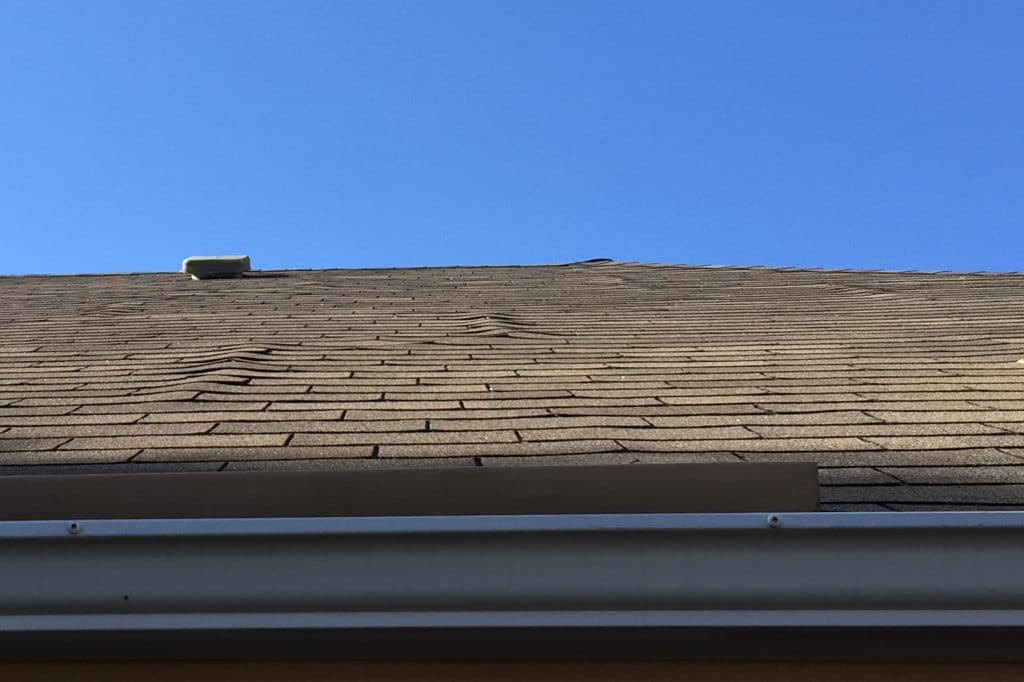
This roof was installed in April 2013 in northern Texas. The shingles are Tamko 20-year 3-tab. There is visible warping three years following the installation, as seen in the attached images. The roofer has recently inspected in the attic, and sees no issues with framing or decking. He has walked the roof and says it is stable. The house was originally built in 1986.
Steve Bliss, of BuildingAdvisor.com responds: Buckling of asphalt and fiberglass shingles is a fairly common occurrence, although it usually occurs in the first year after installation and sometimes diminishes over time.
The most common cause appears to be movement in the roof sheathing with changes in moisture levels. When plywood or OSB sheathing picks up moisture, it expands. If the sheathing is properly gapped, then the gaps can close causing the shingles spanning the gap to buckle. If the sheathing is not gapped, the sheathing itself may buckle, especially with thin sheathing, 24 in. spacing, and significant changes in moisture.
The lack of adequate attic ventilation can increase moisture cycling in the roof sheathing, adding to the problem.
In new construction, it is best to let the roof sheathing acclimate to local conditions before installing the roofing, although this is not always practical.
Another cause of buckling can be wetting of the felt paper, which will expand if it gets wet. If the felt paper is rained on, it’s best to let it dry out before installing shingles.
Finally, I have heard of very cheap asphalt shingles swelling and buckling from moisture absorption, but this should not be the case with a name-brand shingle unless you got a defective batch. Getting the local Tamko rep to take a look would be a good idea. Ask your roofing contractor or the roofing supplier how to submit a claim. While they may and may not not consider this a warranty issue, they may provide some useful insights that can help you solve the problem.
From you photos, my guess is that the buckling is occurring at vertical joints in the roof sheathing. Moisture movement in the sheathing is most likely the cause.
I can’t say whether the higher humidity is caused by outside weather or conditions inside your attic. Perhaps weatherization work or changes in your hvac system have increased humidity levels in the attic. Check for duct leaks or other moisture sources, such as bath fans venting into the attic. A wet basement or crawlspace can also result in a humid attic through the stack effect. Selective air sealing and duct sealing, and increased attic ventilation, may help.
Remember, it’s the relative humidity that wood reacts to, so it’s not always obvious without testing the attic humidity levels and testing the wood with a moisture meter. Ultimately, you may not get a definitive answer unless you remove a few buckled shingles to observe the conditions of the felt paper and sheathing below.
If the contractor and Tamko rep are not cooperative, you may need to hire a professional roofing consultant to take a look. Roofing problems can be tricky to diagnose and solve, but the solution here should be pretty straightforward.
Dan Friedman, Editor of Inspectapedia.com, adds: I agree that it looks as if the buckling is at sheathing butt joints at rafters. Check the buckling pattern for spacing at 4 or 8 ft intervals or a multiple of that. Buckling at sheathing butt joints indeed suggests no gaps but more likely the root cause is nailing errors.
My reasoning: Well-nailed sheathing without gaps may buckle upwards at its center. With mis-nailed sheathing, buckling occurs where the misses occurred.
But center buckling won’t produce such sharp lines of raised shingles. That looks more like lines at edges of sheathing.
Can we get photos of the sheathing from the attic below the places where buckling is seen from outside?
The absence of recommended gaps at sheathing butt joints is very common, but this buckling pattern is not. So I suspect inadequate nailing or perhaps a nail gun user missed the rafter below.
In the attic, look for sheathing not tight to rafter tops and for nails that missed rafters.
Read more on Asphalt Shingles
Kenton Shepard says
Roof Sheathing Needs To Acclimate To Job Site Humidity Before Roofing
A good explanation of asphalt shingle buckling can be found here.
Taylor Sealy says
Looks Like Sheathing Nails Missed Rafter On One Side
Hard to tell from the picture but the description matches what I sometimes see on roofs where the sheathing edge on one side of the rafter was not secured well due to nails missing the rafter. That edge pops up maybe an eighth or quarter inch and makes the lines of raised shingles. Hard to see from the attic sides unless you are right up next to the sheathing. Not sure of the easiest fix for that yet. Maybe screw on a piece of wood to the sheathing from underneath, have someone step on it, and secure it to the rafter from the side.?