
Q: I have an 8-year-old pressured-treated deck that has had a significant amount of wood decay mostly in the framing lumber, but also in some of the decking. The deck is about 5 feet off the ground.
What is the normal life expectancy of treated decking? We used ACQ lumber for the framing and MCA-treated decking. — Sam
A: Up till the early 2,000s, most pressure-treated (PT) lumber used CCA (chromated copper arsenate), and lasted 40 years or more under all but the most demanding conditions. Without a water-repellant finish on decking, it might have checked and cracked, but it did not rot or suffer insect damage. Also, very little leaching of the chemicals was detected in long-term testing.
When CCA was voluntarily phased out of residential use in the early 2000s due to health concerns, a variety of copper-based preservatives were introduced. Most used ACQ (alkaline copper quaternary) or CA (Copper Azole). While the treatment chemical leached out more than CCA, they were considered more benign than the chromium and arsenic in CCA.
Corrosive to Metal
It soon became apparent that the high copper content was very corrosive to steel and aluminum, including nails, screws, framing hardware, and flashing. The lumber industry recommended heavy double-dipped galvanized or stainless steel for any metal in contact with the wood. Fastener manufacturers worked overtime to develop proprietary coatings for screws that were approved for use with AQC and CA lumber.
A second-generation of these preservatives called MCQ (micronized copper quat) and MCA (micronized copper azole), were introduced a few years later to address the corrosion issue. These formulations use extremely fine particles of copper suspended in the treatment solution, with the goal of less leaching of copper and less corrosion in metal fasteners and connectors. Since the copper is not dissolved, it would not form corrosive ions, according to the manufacturer. Also, MCA and MCQ lumber look more like untreated lumber, although over time, they all look the same.
ACQ-Treated Lumber vs. CCA
Since the phase-out of CCA, contractors have questioned whether the new formulations were as effective as the tried-and-true treated wood they had used since the 1930s. Over that past 20 years, there have been numerous anecdotal reports of treated-wood failures with the newer chemicals, and most contractors and lumber dealers will tell you the newer stuff will not last as long as the older CCA type.
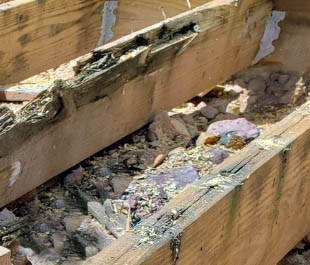
In fact, the older CCA-treated wood would typically last for decades, even buried in the ground. Tests conducted by the US Forest Products Lab using test stakes in the ground showed that CCA-treated lumber treated for ground-contact (.40 pcf) had no failures after 40 years in the ground. There is much less test data on the newer ACQ and other copper-based preservatives.
Canadian testing showed that the 10-year performance of ACQ-treated decking was excellent at standard levels of treatment, but they found some decay in decking boards with low retention levels and untreated end cuts. In buried test stakes, they found “slight to moderate decay” at ground-contact retention levels (.40 pcf) and moderate decay at lower retention levels.
GENERATION DISPUTES
Further disputes go on between the manufacturers of first-generation copper preservatives ACQ and CA and second-generation preservatives MCA and MCA. Viance, a leading manufacturer of ACQ treatment chemicals, claimed that tests it had conducted in Hawaii and Japan showed early failures of MCQ lumber.
However, Viance had to withdraw their comments from marketing literature after a lawsuit by MCQ manufacturer Osmose. Osmose claimed that the samples used in the test were not representative of the products sold in the US construction marketplace.
The jury is still out on whether the newer MCQ and MCA formulations perform as well as ACQ in the field.
RECOMMENDATIONS
While definitive data is lacking, there is enough evidence of problems with treated lumber to suggest that extra precautions are worth taking.
For outdoor decks, good detailing is always a good idea. That means designing decks with an adequate slope and spaced decking to shed water. Also, avoid details that trap pine needles and leaf debris, which tend to stay wet and promote decay. And when they build up, it’s time to clean the deck surface.
Along the tops of the deck joists use strips of peel-and-stick membrane to protect both the tops of the joists and the decking from moisture build up and decay. Also make sure the decking is finished with a suitable decking stain or water-repellant preservative, cleaned regularly, and refinished as needed.
Use appropriate fasteners and steel connectors, rated for use with pressure-treated lumber. For critical pieces of hardware, strongly consider upgrading the stainless steel. Stainless-steel deck screws are also a good idea.
Under the deck provide good drainage and ventilation and use a plastic or membrane ground cover for decks close to grade.
With pressure-treated (as well as hardwood) decking and framing lumber treat all cut ends with a commercial end-cut sealer or a field-applied preservative such as copper naphthenate.
Finally, choose lumber and decking with a treatment level that is suitable for the application. Each piece of treated lumber will have a stamp or tag on the end identifying the treatment grade. Treatment levels are standardized by the AWPA as shown in the chart below.
| AWPA Lumber Treatment Categories | |
| Application &
Use Category |
Treatment Retention Levels (lb/cu. ft.) |
| Above-grade (UC3B) | ACQ .25
CA-B .10 MCA .15 |
| Ground contact, general use (UC4A | ACQ .40
CA-B .21 MCA .23 |
| Ground contact, heavy duty (UC4B) | ACQ .60
CA-B .31 |
If the deck is close to the ground, or you are in a damp climate, consider upgrading the framing to ground-contact. For lumber in ground-contact, consider upgrading the heavy-duty ground contact. — Steve Bliss, BuildingAdvisor.com
Read More about:
Building Sturdy Decks
Wood Decking
Composite Decking
Deck Stains & Finishes
Fasteners & Connectors
Framing Materials
Deck Railingsout
Leave a Reply