• Skip to main content
  • Skip to secondary menu
  • Skip to primary sidebar
  • Skip to secondary sidebar

Building Advisor

Practical Building Advice

search icon

Search This Site

search icon
  • About Us
  • Contact Us
  • HOME
  • BUYING LAND
    • OVERVIEW
    • GETTING STARTED
    • LAND CHECKLIST
    • IS IT BUILDABLE?
    • ZONING
    • LAND REGULATIONS
    • SEPTIC SYSTEMS
    • WATER WELLS
    • SITING A HOUSE
    • SITE EVALUATION
    • QUESTIONS TO ASK WHEN BUYING LAND
    • SITE DEVELOPMENT BUDGETING
    • TYPICAL COSTS
    • REAL ESTATE AGENTS
    • MAKING AN OFFER
    • LESSONS LEARNED
  • DESIGN
    • OVERVIEW
    • PLANS & SPECS
    • SITE PLANNING
    • SITING A HOUSE
    • FLOOR PLANS
    • HIRING AN ARCHITECT
    • HIRING A DESIGNER
    • DESIGN-BUILD CONTRACTORS
  • HIRING
    • OVERVIEW
    • GETTING STARTED
    • TASKS & PLAYERS
    • ARCHITECTS
    • DESIGNERS
    • CONTRACTORS
    • SUBCONTRACTORS
    • DESIGN-BUILD CONTRACTORS
    • CONSTRUCTION MANAGERS
    • OWNER-BUILDERS
    • REAL ESTATE AGENTS
  • ESTIMATING
    • OVERVIEW
    • COST OVERRUNS
    • PRELIMINARY BUDGETING
    • BALLPARK ESTIMATES
    • PRICING GUIDES
    • CONTRACTOR ESTIMATES
    • OWNER-BUILDER ESTIMATES
    • REMODELING ESTIIMATES
    • STEP-BY-STEP GUIDE
    • OVERHEAD & PROFIT
    • ESTIMATING SPREADSHEET
    • ESTIMATING FAQs
  • BIDDING
    • OVERVIEW
    • PRICING THE JOB
    • FIXED-PRICE BIDS
    • COST-PLUS BIDS
    • DESIGN-BUILD BIDS
    • NEGOTIATED BIDS
  • CONTRACTS
    • OVERVIEW
    • CONTRACT BASICS
    • CRITICAL CLAUSES
    • STANDARD CONTRACTS
    • MODEL CONTRACT
    • SIMPLE PROPOSALS
    • WRITTEN SPECS
    • ALLOWANCES
    • CHANGE ORDERS
    • DOCUMENTATION
    • DISPUTE RESOLUTION
  • FINANCE
    • OVERVIEW
    • WHAT’S YOUR BUDGET?
    • GETTING BIDS
    • OVERHEAD & PROFIT
    • CONSTRUCTION LOANS
    • DOWN PAYMENTS
    • DRAW SCHEDULES
    • ALLOWANCES
    • CHANGE ORDERS
    • LIEN WAVERS
    • THE FINAL CHECK
  •   
  • WELLS
    • OVERVIEW
    • WELL DRILLING
    • FROM WELL TO TAP
    • WATER QUALITY
    • WATER TREATMENT
  • SEPTIC
    • OVERVIEW
    • HOW IT WORKS
    • PERC TESTING
    • ALTERNATIVE SEPTIC SYSTEMS
    • SEPTIC SYSTEM MAINTENANCE
    • SEPTIC SYSTEM FAQs
  • FOUNDATIONS
    • OVERVIEW
    • DRY BASEMENT DETAILS
    • SITE DRAINAGE
    • WATERPROOFING
    • BASEMENT INSULATION
    • CRAWLSPACES
    • SITE EVALUATION
    • SITING A HOUSE
  • EXTERIORS
    • OVERVIEW
    • ALL EXTERIORS LEAK
    • RAIN-SCREEN WALLS
    • SHEATHING WRAP
    • WINDOW FLASHING
    • WALL FLASHING
    • FLASHING MEMBRANES
    • METAL FLASHINGS
    • PAINTING & STAINING
  • DECKS
    • OVERVIEW
    • STRUCTURAL DETAILS
    • FRAMING MATERIALS
    • DECK RAILINGS
    • WOOD DECKING
    • COMPOSITE DECKING
    • DECK STAINS & FINISHES
    • FASTENERS & CONNECTORS
  • FREE FORMS
    • FORMS INDEX
  • BUILDING FAQ’S
    • BROWSE Q&A’s
    • Q&A INDEX
You are here: Home / Decks & Porches / Stainless-Steel vs. Galvanized Joist Hangers

Stainless-Steel vs. Galvanized Joist Hangers

September 9, 2021 by buildingadvisor 2 Comments

Q: I am planning an above ground (30 inches) storage shed that will be built in a salt-air environment in the Outer Banks of North Carolina.  I plan to use 2×6 floor joists with joist hangers.

Do I really need to use stainless-steel? I am looking at a 15- to 20-year projected life for the structure.  If I can get by without the cost of stainless-steel, what specification joist hanger should I use for that environment. — Donald D.

A: Stainless steel is the gold standard. For all practical purposes, marine-grade Type 316 stainless-steel will last forever – at least it will outlast you and me. Type 304 stainless steel is a little cheaper and a little less durable in corrosive environments like salt air. However you will find that Type 316 is more readily available in framing hardware.

At a minimum, you will want to use steel hardware with a heavy galvanized coating. For light-gauge steel like joist hangers, that means G185 galvanized steel, which has 1.85 oz. of zinc per sq. ft. of surface area (of the coated material). This type of coating is marketed at Zmax G185 by connector manufacturer Simpson or G185 Triple Zinc by USP.
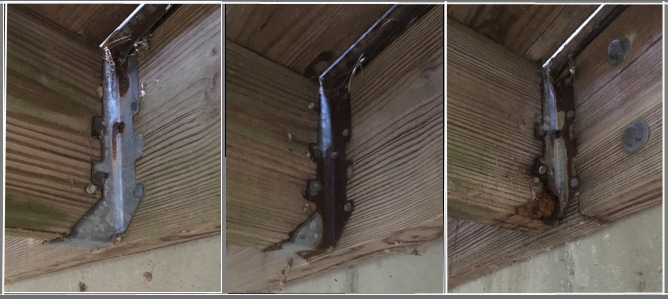
Galvanized joist hangers will eventually rust through if exposed to salt air.
Galvanized joist hangers will not last forever in a coastal environment, but their lifespan is hard to predict. Over 20 years, these three identical hangers on the same deck vary from light rust (left) to extensive rust (center) to complete failure (right).


There are too many variables to predict the specific lifespan for a galvanized coating. However, all galvanized coatings are sacrificial and will not last forever. Often one galvanized steel framing connector rusts away while the same item 2 ft. away is fine.

How often the material gets wet and stays wet, and the degree of exposure to salt air and salt spray are big factors. But it’s not always apparent why one connector survives and the next one turns to rust.  I used galvanized hangers on a deck built about ¼ mi. from the ocean about 20 years ago. Of  the 16 joist hangers used, about half are rusted pretty badly and two have completely rusted through the seat of the hanger. The rest look pretty good (see photo above).

Unless you are very close to salt water with direct exposure to salt spray, a G-185 hanger will probably get the 15 to 20 year life span you are after. But I would recommend inspecting the hangers on occasion.


Bottom line, if a joint is critical to the support of a deck or building or is inaccessible, I would highly recommend stainless steel. If it’s not so essential to the structure, and you’re able to inspect and replace as needed, heavy-duty galvanized is acceptable. — Steve Bliss, BuildingAdvisor.com


Filed Under: Decks & Porches Tagged With: Construction Defects, Flashing

Reader Interactions

Comments

  1. Richard Peterson says

    October 26, 2022 at 12:03 pm

    Type 305 vs. 316 Stainless Steel for Coastal Construction

    Can you describe the difference between the use of Type 316 stainless-steel and 305 stainless joist hangers and framing brackets for use in building a pier over a coastal estuary? Is there any consideration to coating the 305 steel to prolong the life of those brackets, assuming they will not hold up as well as the Type 316 material?

    Reply
    • buildingadvisor says

      October 26, 2022 at 5:58 pm

      Type 316 stainless steel is more corrosion-resistant than Type 305, mainly due to the addition of molybdenum (2% max), which provides excellent protection against chlorides (salts), and other corrosive chemicals. For that reason, Type 316 is recommended for use around salt water and marine environments.

      Type 305 stainless-steel hardware (as well as Types 302, 303, 304) is likely to pit and discolor from exposure to salt spray in your application, and could bleed through finishes, but the steel should remain structurally sound.

      There are coatings that improve the corrosion resistance of steel alloys, but these are used mainly in industrial applications and are applied by the manufacturer. I am not aware of any site-applied coatings that will improve the corrosion resistance of stainless steel.

      Reply

Leave a Reply Cancel reply

Your email address will not be published. Required fields are marked *

Primary Sidebar

Visit Inspectapedia.com our Sister Site

Secondary Sidebar


ESTIMATING SPREADSHEET SPECIAL

Only $19.95 for Lifetime License LEARN MORE


Share this article


Q&A INDEX


Recent Posts

  • Best Approach to Hot-Climate Cathedral Ceiling
  • Frost-Protected Shallow Foundations
  • Patios & Decks for Coastal Homes
  • Can I Foam Basement Wall With Existing Studs?
  • Is Top Railing On Deck Code-Approved?

Copyright © 2025 · Magazine Pro for Building Advisor on Genesis Framework · WordPress · Log in