
Q: Why is the cold water inlet pipe on my water heater hot up to five feet away?
Thanks in advance! — Jan O.
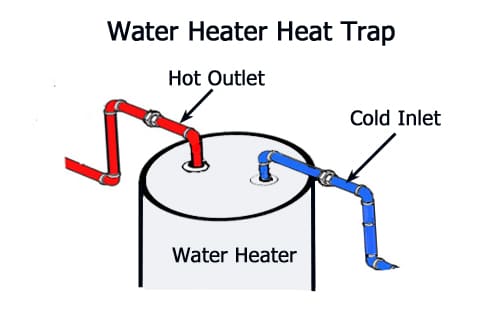
A: It is normal for the incoming cold water pipe to get a little warm due to convection – that is, hot water rising in the tank. Also copper piping is a good conductor of heat. Many modern water heaters have built-in heat traps to limit the migration of hot water.
However, hot water five feet back on the supply line is not normal. There are a few possibilities:
- The installer used a torch too close to the top of the water heater when installing it and damaged internal components. For example, there could be a hole in the dip tube, which supplies hot water to the bottom of the tank.
- There is cross-contamination between hot and cold lines. For example, this can happen in a defective shower valve or washing machine mixing valve — or even a single-handle faucet
A check valve can be installed with an expansion tank between the water heater and check valve, but this is rarely done unless you have a water softener nearby or a recirculating hot-water system (to provide instant hot water to distant fixtures in a large home).
An improperly installed or malfunctioning thermostatic mixing valve could also be a factor. This is a whole-house anti-scald system that allow you to keep the water heater set very high – around 140 degrees F, while delivering hot water to fixtures at 120 degrees.
Many people, myself included, just set their water heaters at a lower temperature – around 120 degrees to protect against scalding and save energy. The lower the temperature of the storer water, the less the heat loss. Some experts are concerned that this introduces a risk of Legionnaire’s Disease brewing in your water heater, but it’s not something I worry about.
You can also have your plumber install external heat traps in your piping entering and exiting the water heater. This is simply an inverted “U” in the inlet and outlet pipes that keep the hot water from migrating (see diagram). Insulating the hot sections of pipe is also a good way to prevent heat loss.
First thing, however, it to have a licensed master plumber take a look and figure out what is causing the problem. — Steve Bliss, Editor, BuildingAdvisor.com
Sandra Acker says
My gas hot water heater is in shed. My a/c man just said my water pipe was very hot in attic and do I have a leak? I used hot water for dishes 3 hours ago. I don’t hear a dripping noise in house. Do I have a leak?
buildingadvisor says
The best approach I know to detect a hidden leak is to turn off all water lines, hot and cold, for 12-24 hours. Read the meter before and after your test. If the meter has moved, then you have a leak after the meter — that is, inside your home plumbing. If you can’t locate the leak, get a plumber to take a look.
Sometimes hot water convection can heat the pipe a few feet away from water heater, but this sounds like it is a long distance away.
Please let me know if you solve the problem. Any input from other readers is welcome!
Eldon Driscoll says
Why Is Water Heater Output So Low?
I have a question. Both of the copper pipes, hot and cold, connected to the hot water tank are hot. I have a 40 gallon tank, but can only get one shower from this hot water tank before it goes cold. Elements work fine. Would you know the cause or reason?
buildingadvisor says
Assuming that the two elements are working properly, and the unit is properly sized, there are a number of possibilities.
If the system is old, or you have hard water, there may be sediment build-up which can hurt efficiency and output.
Hard water can also cause scale to build up on one or both elements, causing similar problems.
It’s possible that one of the thermostats has malfunctioned. A bad upper thermostat can result in too little hot water, while a lower thermostat that malfunctions will cause slow recovery.
Finally, the dip tube inside the water heater, which brings cold water to the bottom of the tank, could be broken or disconnected, significantly reducing hot water output.
As for the hot pipe, a little hot water often circulates into the cold water feed by convection, as described in the article above, but should not affect heat output.
If you don’t want to spend money on repairs right now, you can try raising the two thermostats on your water heater. For scald protection, most experts recommend not exceeding 120 degrees F. If you want to go above 125 degrees, I would highly recommend adding an anti-scald mixing valve to the hot-water line.
FRANCISCO frank de la cruz says
Why Does Cold-Water Line Run Hot for First Gallon?
I have a problem in my house, it all a sudden hot water ran through the cold-water line and it takes about gallon or better before cold water flows.
buildingadvisor says
There are a number of possible causes, but some of most likely are:
– Problems with the water expansion tank check valve (if you have one).
– Water pressure is too high
– Heat trap is damaged or missing
– Mixing valve (if you have one for scald protection) is malfunctioning.
– Defective mixing valve in washing machine, shower, or single-handle faucet.
Since plumbing not my strongest suit in the building trades, with this type of problem, I call the plumber.
FRANCISCO frank de la cruz says
I just found the problem. I have 6 Pfister one-handle valves and all of sudden I had no hot water. Instead I only had cold water in bathtub valve both hot and cold lines. I replaced the valve and this
corrected the problem.
Dan Friedman says
Heat Traps and Clicking Noises
1. Water heater noises are discussed at WATER HEATER NOISES https://inspectapedia.com/plumbing/Water_Heater_Noises.php
Excerpt:
Clicking sounds in the water heater or geyser: probably thermal expansion among water heater parts or hot water distribution piping.
Modest water heater clicking or tapping sounds may be considered normal if they’re occurring in a heat trap installed in the hot water supply piping above / downstream from the water heater itself. The heat trap is a device intended to prevent hot water from circulating or rising in the distribution piping before there is a call for hot water by opening a tap.
Clicking noises are normal during the ignition phase of gas-fired water heaters and gas fired tankless water heaters that use electron ignition – a feature on virtually all modern tankless water heaters and most new gas fired water heaters.
Also check the routing of hot water piping: hot water pipes passing through too-tight openings may click, tap, or even squeak as the metal hot water pipes expand during hot water flow through them.
Also see this heat trap bulletin https://www.hotwater.com/lit/bulletin/bulletin12.pdf from AO Smith

2. Hot water heating systems have a similar problem if the normal check valve at the boiler is not working or has been manually left open: heat circulates through the building even when the thermostat is not calling for heat. This problem is probably better known.