• Skip to main content
  • Skip to secondary menu
  • Skip to primary sidebar
  • Skip to secondary sidebar

Building Advisor

Practical Building Advice

search icon

Search This Site

search icon
  • About Us
  • Contact Us
  • HOME
  • BUYING LAND
    • OVERVIEW
    • GETTING STARTED
    • LAND CHECKLIST
    • IS IT BUILDABLE?
    • ZONING
    • LAND REGULATIONS
    • SEPTIC SYSTEMS
    • WATER WELLS
    • SITING A HOUSE
    • SITE EVALUATION
    • QUESTIONS TO ASK WHEN BUYING LAND
    • SITE DEVELOPMENT BUDGETING
    • TYPICAL COSTS
    • REAL ESTATE AGENTS
    • MAKING AN OFFER
    • LESSONS LEARNED
  • DESIGN
    • OVERVIEW
    • PLANS & SPECS
    • SITE PLANNING
    • SITING A HOUSE
    • FLOOR PLANS
    • HIRING AN ARCHITECT
    • HIRING A DESIGNER
    • DESIGN-BUILD CONTRACTORS
  • HIRING
    • OVERVIEW
    • GETTING STARTED
    • TASKS & PLAYERS
    • ARCHITECTS
    • DESIGNERS
    • CONTRACTORS
    • SUBCONTRACTORS
    • DESIGN-BUILD CONTRACTORS
    • CONSTRUCTION MANAGERS
    • OWNER-BUILDERS
    • REAL ESTATE AGENTS
  • ESTIMATING
    • OVERVIEW
    • COST OVERRUNS
    • PRELIMINARY BUDGETING
    • BALLPARK ESTIMATES
    • PRICING GUIDES
    • CONTRACTOR ESTIMATES
    • OWNER-BUILDER ESTIMATES
    • REMODELING ESTIIMATES
    • STEP-BY-STEP GUIDE
    • OVERHEAD & PROFIT
    • ESTIMATING SPREADSHEET
    • ESTIMATING FAQs
  • BIDDING
    • OVERVIEW
    • PRICING THE JOB
    • FIXED-PRICE BIDS
    • COST-PLUS BIDS
    • DESIGN-BUILD BIDS
    • NEGOTIATED BIDS
  • CONTRACTS
    • OVERVIEW
    • CONTRACT BASICS
    • CRITICAL CLAUSES
    • STANDARD CONTRACTS
    • MODEL CONTRACT
    • SIMPLE PROPOSALS
    • WRITTEN SPECS
    • ALLOWANCES
    • CHANGE ORDERS
    • DOCUMENTATION
    • DISPUTE RESOLUTION
  • FINANCE
    • OVERVIEW
    • WHAT’S YOUR BUDGET?
    • GETTING BIDS
    • OVERHEAD & PROFIT
    • CONSTRUCTION LOANS
    • DOWN PAYMENTS
    • DRAW SCHEDULES
    • ALLOWANCES
    • CHANGE ORDERS
    • LIEN WAVERS
    • THE FINAL CHECK
  •   
  • WELLS
    • OVERVIEW
    • WELL DRILLING
    • FROM WELL TO TAP
    • WATER QUALITY
    • WATER TREATMENT
  • SEPTIC
    • OVERVIEW
    • HOW IT WORKS
    • PERC TESTING
    • ALTERNATIVE SEPTIC SYSTEMS
    • SEPTIC SYSTEM MAINTENANCE
    • SEPTIC SYSTEM FAQs
  • FOUNDATIONS
    • OVERVIEW
    • DRY BASEMENT DETAILS
    • SITE DRAINAGE
    • WATERPROOFING
    • BASEMENT INSULATION
    • CRAWLSPACES
    • SITE EVALUATION
    • SITING A HOUSE
  • EXTERIORS
    • OVERVIEW
    • ALL EXTERIORS LEAK
    • RAIN-SCREEN WALLS
    • SHEATHING WRAP
    • WINDOW FLASHING
    • WALL FLASHING
    • FLASHING MEMBRANES
    • METAL FLASHINGS
    • PAINTING & STAINING
  • DECKS
    • OVERVIEW
    • STRUCTURAL DETAILS
    • FRAMING MATERIALS
    • DECK RAILINGS
    • WOOD DECKING
    • COMPOSITE DECKING
    • DECK STAINS & FINISHES
    • FASTENERS & CONNECTORS
  • FREE FORMS
    • FORMS INDEX
  • BUILDING FAQ’S
    • BROWSE Q&A’s
    • Q&A INDEX
You are here: Home / Basement Leakage / How To Stop Leak Onto Garage Floor?

How To Stop Leak Onto Garage Floor?

February 13, 2021 by buildingadvisor Leave a Comment

Q: We recently purchased a property that has an old detached garage on it.  Water is leaking into the garage all around the perimeter at the bottom of the wall (first photo). The garage is slab-on-grade construction with a 12-in.-high concrete stem wall placed on top of the slab. The problem is that the slab extends 6 in. beyond the stem wall, forming a horizontal skirt around the exterior of the garage (second photo).
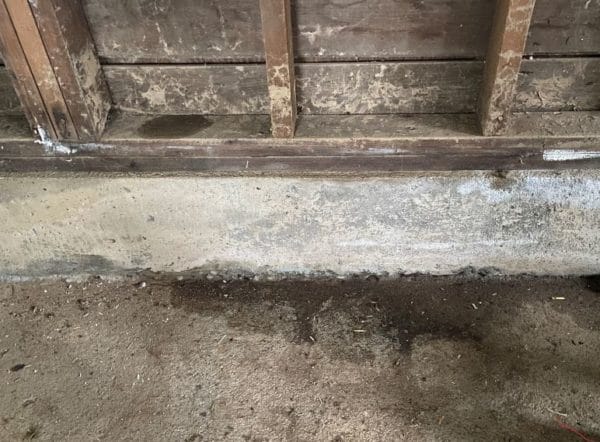
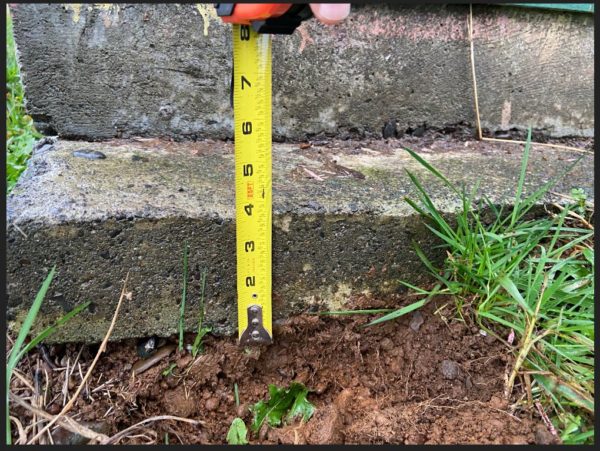
Water leakage along bottom of garage wall
Water leaked onto the garage floor along the bottom of the concrete stem wall.
Garage slab design caused water leakage into garage.
The garage slab extended beyond the stem wall, directing water into the garage.


We live in Western Washington where we get a ton of rain.  Due to this design, the rain hits the wall, drips down onto the 6 in. skirt and then seeps into the garage where the stem wall joins the slab.  (The stem wall was a separate pour of concrete from the slab and the water comes in at various points around the garage).

As none of this is below grade, I can find no guidance on how to waterproof this seam and would love some help.  We believe this garage was built pre-1940’s  on an old farm.  — Chris H.


A: Your theory that the water is leaking in at the bottom of the stem wall is the most likely explanation. The way they built your slab and wall is unusual and almost guaranties a leak where the concrete stem wall sits on the slab.

In modern construction, the slab does not extend past the bottom of the stem wall. Either the slab sits inside the stem wall, or with a monolithic slab, the bottom wall plate sits along the edge of the slab with the sheathing or siding preventing water entry.

This leak could have been easily prevented by using a concrete bonding agent at the bottom of the stem wall when they poured the concrete. But it’s too late for that approach.
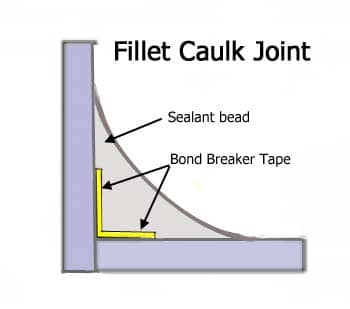


A corner bead of sealant, called a fillet joint, is likely to fail over time. Backer rod or bond-breaker tape in the corner will help.


At this point, you will have to seal the crack in the corner where the stem wall meets the slab. Sealing this type of right-angle joint with a triangular bead of sealant is called a fillet seal – a difficult job for most sealants (see pic).

The most effective place to seal a water leak is always on the exterior, but if that is not practical, you could try the interior side of the joint. Because the leak is above grade, without hydrostatic pressure, an inside seal might work, but it’s not ideal.

You will need to clean and dry the joint before attempting to seal it. On the exterior, that would probably require pressure washing. Then use a stiff wire brush and vacuum to remove any residue. On the interior, a hose or sponge would probably work, followed by the wire brush.

Then you will need a high-grade, flexible sealant formulated for use with concrete.  Avoid concrete sealants that are “self-leveling” as these will not hold the shape you want. Look for a non-sag sealant, that says it is suitable for vertical control joints.

My first choice would be a urethane sealant, such as Sikaflex Concrete Fix or Loctite PL-S10 Concrete Crack Sealant. You can get these at most lumberyards and home centers, but I would not buy online as urethane sealants have a limited shelf life. If you absolutely can’t get the joint dry, you could try a product like Sikaflex Construction Sealant formulated for use with wet concrete.

If you can get the joint reasonably clean and dry before sealing, you should be good to go. — Steve Bliss, BuildingAdvisor.com

Filed Under: Basement Leakage, Foundations Tagged With: Basement Leakage, Construction Defects, Moisture Problems

Reader Interactions

Leave a Reply Cancel reply

Your email address will not be published. Required fields are marked *

Primary Sidebar

Visit Inspectapedia.com our Sister Site

Secondary Sidebar


ESTIMATING SPREADSHEET SPECIAL

Only $19.95 for Lifetime License LEARN MORE


Share this article


Q&A INDEX


Recent Posts

  • Best Approach to Hot-Climate Cathedral Ceiling
  • Frost-Protected Shallow Foundations
  • Patios & Decks for Coastal Homes
  • Can I Foam Basement Wall With Existing Studs?
  • Is Top Railing On Deck Code-Approved?

Copyright © 2026 · Magazine Pro for Building Advisor on Genesis Framework · WordPress · Log in